Taepper Farm

Delivering a contemporary farmhouse for modern family living within a protected rural landscape

Client

Private Client

Location

Martock, Somerset

RIBA Work Stages

0-3

Services

Town Planning, Architecture

Overview

What began as an approved Class Q barn conversion scheme for five dwellings evolved into a more deliverable, better designed and commercially attractive rural development through a carefully considered planning strategy.

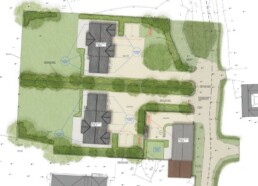
Working closely with the landowner, BoonBrown identified an opportunity to improve upon the extant permission by replacing the approved conversion-led scheme with a development comprising two new-build homes and one barn conversion, creating three high-quality self-build dwellings that better responded to the site’s character, setting and long-term future. The approved scheme also unlocked significant viability benefits by avoiding the need for phosphate mitigation credits, Community Infrastructure Levy (CIL) contributions and Biodiversity Net Gain (BNG) provision

Planning challenges

Turning an existing consent into a better development opportunity


The site benefited from an extant and implementable Prior Approval permission for the conversion of three agricultural buildings into five dwellings under Class Q legislation. While the principle of residential development had already been established, the approved scheme presented limitations in terms of design flexibility, buildability and long-term value.

The challenge was to demonstrate that an alternative form of development could deliver a higher-quality outcome while remaining acceptable in planning terms. At the same time, the proposal needed to navigate a range of evolving planning and environmental considerations, including phosphate neutrality requirements, Biodiversity Net Gain regulations and local planning policy considerations.

A successful outcome would require a robust evidence-based strategy that built upon the site’s established residential fallback position while delivering clear planning benefits.

Our approach

Unlocking value through strategic planning advice


The strategy centred on leveraging the extant Class Q permission, which had already established the principle of residential development and created a strong fallback position.

Key elements of the planning strategy included:

  1. Retaining and converting one agricultural building while replacing the remaining approved conversions with two bespoke family homes.
  2. Designing a lower-density scheme that responded more positively to the rural character of the site and surrounding landscape.
  3. Utilising previously developed land associated with the existing farmstead.
  4. Building upon the approved five-dwelling fallback position to demonstrate reduced environmental impacts.
  5. Creating a self-build development aligned with local and national planning objectives supporting custom and self-build housing.
Outcome

Planning permission secured with significant viability benefits


Planning permission was successfully secured for two new-build dwellings and the conversion of one agricultural barn, replacing the previously approved five-unit Class Q scheme.

Importantly, the approved development was granted without the requirement for phosphate mitigation credits, Community Infrastructure Levy (CIL) payments or Biodiversity Net Gain provision, resulting in substantial cost savings and enhanced project viability. The proposal also generated a lower phosphate loading than the extant five-dwelling permission, providing an environmental betterment alongside a reduced development intensity.

By building upon an existing planning position and identifying a more effective route forward, BoonBrown helped deliver a scheme that combined planning certainty, commercial value and design quality, creating three distinctive rural homes with a clear and sustainable future.

Privacy Preference Center