
On the Road to Net Zero

Our latest progress towards minimising our Carbon Footprint
As part of BoonBrown’s Social Value Strategy, over the last four years we have been calculating and tracking the Carbon Footprint of our Southwest and London Studios. In 2023, we launched our inaugural Carbon Reduction Plan which outlined our baseline Carbon Footprint along with the carbon reduction initiatives we have implemented and proposed. Since the publication of this plan, we have continued to assess our carbon impact and have recently released an updated Carbon Reduction Plan, now available for viewing on our website here.
As a practice, we are committed to reducing our carbon footprint to achieve Net Zero by 2040. This aligns with the government’s goal to achieve Net Zero emissions in the UK by 2050. The first step in reducing our carbon footprint was to measure our existing impact so that we could identify areas of improvement. For emissions which cannot practicably be reduced, we will look at offsetting measures to reach our target goal of Net Zero.
2024 Analysis
Our 2024 Carbon Footprint is slightly less than our baseline year of 2022, and we have seen a marked decrease in our carbon footprint in 2024 compared to 2023. Our Scope 2 emissions have increased slightly from 11.78 tonnes CO2e in 2023 to 12.50 tonnes CO2e in 2024. However, there has been a reduction in Scope 3 emissions from 71.80 to 66.76 tonnes CO2e.
When considering BoonBrown’s carbon footprint per employee, we have continued to see a reduction from 1.82 tonnes CO2e in 2022, to 1.69 tonnes CO2e per employee in 2024. This is a reduction of approximately 7.1% since we began recording our Carbon Footprint in 2022.
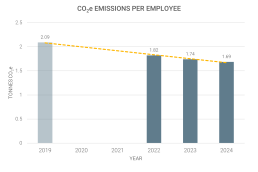
Measuring our carbon footprint continues to highlight some interesting findings and statistics, helping to raise awareness of our environmental impact, both collectively as a business and individually through our own day-to-day activities. It also gives weight to the environmental procedures we implement as part of our ISO14001 accreditation.
Read on for a reminder of how we calculate our Carbon Footprint.
Scope 1, 2 & 3 Emissions
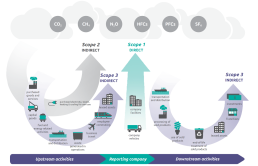
There are three ‘Scopes’ which make up our Carbon Footprint calculations, as defined by the Greenhouse Gas Protocol (GHG Protocol) established in 1998:
- Scope 1 covers all direct emissions from sources controlled by an organisation, such as burning fuel in company vehicles, refrigerants, and burning gas in boilers.
- Scope 2 includes indirect greenhouse gas emissions from purchased energy, such as electricity, heating, cooling, and steam.
- Scope 3 covers all remaining indirect greenhouse gas emissions from activities, from sources not owned or controlled by an organisation.
Scope 1 and 2 emissions are generally easy to quantify and record. However, Scope 3 emissions are much harder to measure despite typically accounting for 65% – 95% of an organisation’s total Carbon Footprint. Measuring Scope 3 emissions requires extensive assessment of the supply chain, including both upstream and downstream activities, and often relies heavily on estimates and third-party data.
BoonBrown Carbon Footprint
Our Carbon Footprint is calculated in tonnes of CO2e, or Carbon Dioxide Equivalent. This is a metric measure used to compare emissions of different greenhouse gases based on their global warming potential.
At BoonBrown, our Scope 3 emissions account for approximately 84% of our total Carbon Footprint and are broken down into the following categories:
- Employee Commuting
Calculated based on miles travelled, by transport and fuel type.
- Business Travel
Calculated in the same way as Employee Commuting.
- Business Accommodation
Based on number of nights spent in hotel accommodation.
- Waste and Recycling
Calculated based on total weight of items recycled or sent to landfill, which is recorded as part of our ISO14001 processes.
- Water Usage
Calculated using total water consumption in m3.
- Employees Working from Home
Based on average number of days per week spent working from home.
We used the Small Business Carbon Calculator created by Climate Impact Partners to convert our collected data into tonnes of CO2e.
Our total Carbon Footprint for 2022 was calculated at 80.11 tonnes CO2e, equal to approximately 20 elephants! In 2023 this increased slightly to 83.58 tonnes CO2e which can be attributed to additional recruitment and a return to normal working practices after Covid. However in 2024 we saw a marked reduction to 79.26 tonnes CO2e. When calculated as an average per employee, we saw a reduction of 7.1% compared to our baseline 2022 figure. A full breakdown of our calculations and the emissions attributable to each of the above categories is available in our Carbon Reduction Plan on our website here.
What have we learnt?
This exercise continues to be an enlightening process and allows us to learn more about the theory behind carbon footprint calculation as well as better understanding the environmental impact of our practices and individual actions. Sharing the findings with our teams in London and Yeovil has given weight to the environmental procedures we implement as part of our ISO14001 accreditation, encouraging staff to adopt new ways of working to reduce our carbon footprint.
In 2022, much of the data for our London Studio was calculated based on averages in the Southwest office. Over 2023, we increased our data collection in both studios which has since improved the accuracy of our calculations, and we continue to build on this data collection year-on-year.
Carbon Reduction Initiatives
Our Carbon Reduction Plan outlines both our implemented and proposed carbon reduction initiatives in detail. Below are some examples of initiatives at an individual level that all employees are implementing in their day-to-day working practices:
- Encouraged staff to switch to ‘green’ search engines, such as Ecosia, which uses profits from advertising to plant trees across the globe.
- Reduced individual desk bins and increased recycling bins, including the introduction of a food waste bin, to encourage proper recycling of waste.
- Turning off equipment when not in use, including lights, printers, PCs overnight and monitors when not at your desk.
- Only printing when necessary.
- Encouraged car sharing when commuting or attending remote meetings.
- Improved bike storage in the Southwest Studio to encourage cycling to work.
- Unplugging electrical items when fully charged and switching to reusable batteries where possible.
- Switching to LED lighting in the Yeovil Studio as existing fluorescent lighting fail to reduce energy consumption.
- Job files and invoicing have transitioned to paperless.
As a practice working in the construction industry, we are well placed to make positive ‘greener’ choices when designing and delivering our projects, encouraging and assisting clients to incorporate sustainable technologies and reducing the carbon impact of development where possible. As we continue to develop our Net Zero strategy, we plan to actively seek opportunities for further offsetting solutions such as tree planting and habitat creation.