Beaucroft College
Retrofitting for Learning and Life
Client
Location
RIBA Work Stages
Services

Overview
Sustainability is often associated with new buildings, but at Beaucroft College the greatest opportunity lay in reimagining what already existed.
Working closely with Dorset Council and the college community, BoonBrown transformed the former Wimborne First School into a modern specialist educational environment for students with special educational needs. Rather than demolishing and rebuilding, the project focused on retaining, improving and decarbonising the existing buildings, unlocking a sustainable future while preserving the character and history of the site.
The result is a campus that supports learning, wellbeing and community engagement while significantly reducing operational carbon emissions.
A retrofit-first approach
At the heart of the project was a commitment to reuse.
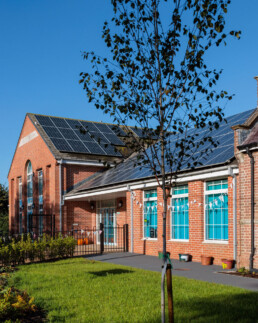
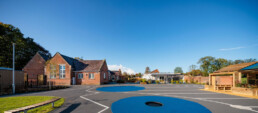
Existing buildings were carefully upgraded to modern standards, extending their lifespan and dramatically reducing the environmental impact associated with demolition and new construction. Historic features, including the original roof structure and double-height windows, were restored and celebrated, creating bright and characterful learning spaces that connect the college’s future with its past.
Fabric improvements included:
Internal wall and roof insulation
Replacement double-glazed windows and doors
Improved airtightness and thermal performance
Increased natural daylight through the introduction of new rooflights
These interventions significantly improved comfort, energy efficiency and long-term building performance.
Decarbonising for the future
In 2021, the project secured government SALIX funding to support a comprehensive decarbonisation strategy.
Two ageing gas boilers were decommissioned and replaced with an air source heat pump, removing reliance on fossil fuel heating. Solar photovoltaic panels were also introduced to generate renewable electricity on site, reducing operational energy demand and supporting the college’s journey towards net zero.
The combined measures are predicted to deliver:
76% reduction in CO₂ emissions
Renewable energy generation through on-site photovoltaics
Fossil fuel-free heating and hot water provision
EPC ratings improved to B and C
This investment ensures the campus is better equipped to meet future environmental targets while reducing long-term operational costs.
Learning spaces designed around wellbeing
Sustainability at Beaucroft extends beyond energy performance.
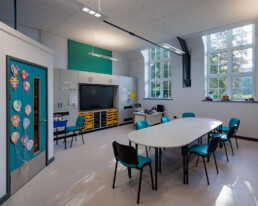
The transformation placed equal importance on creating healthy, inclusive environments for students. Open classrooms, integrated teaching walls, dedicated quiet rooms and specialist sensory spaces were designed to support a wide range of learning needs.
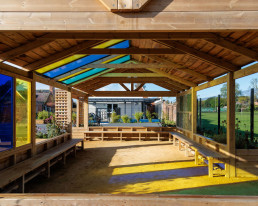
Mechanical ventilation with heat recovery delivers fresh air throughout the learning environments, improving comfort while maintaining energy efficiency. Outside, former areas of hard tarmac have been replaced with landscaped play spaces, outdoor learning areas and nature-based environments that encourage exploration, wellbeing and connection with the outdoors.
Building skills through sustainable design
The project’s educational value reaches beyond the classroom.
A new Life Skills facility enables students to develop practical everyday skills, including cooking, cleaning and bicycle maintenance. Students also have opportunities to grow produce, prepare food and engage with the college’s community café, fostering independence and strengthening community connections.
These facilities demonstrate how sustainable design can create social value alongside environmental benefits.
Innovation through collaboration
Delivering a large-scale retrofit and decarbonisation project required close collaboration between Dorset Council, Beaucroft College, engineers, contractors and the wider design team.
Stakeholder engagement played a key role throughout the process, ensuring that staff, students and the wider college community helped shape the final outcome. Regular consultation and site visits enabled the project to evolve around the needs of its users while maintaining ambitious sustainability objectives.
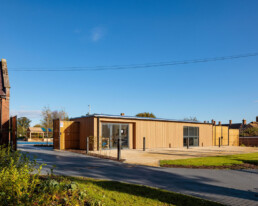
Further innovation was embedded within the new Life Skills teaching block, which was designed using Passivhaus principles and constructed using prefabricated timber-frame technology to enhance thermal performance and reduce construction impacts.
At a glance

Scale

Design

Sustainability

Wellbeing

Community

Impact
Summary